
Precision Neuropsychiatry through nmda
Critical Target for Neuropsychiatry
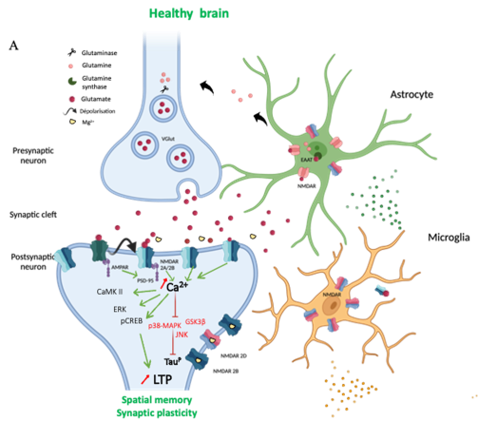
NMDAR is an ionotropic channel which, upon activation, let calcium enter the cell, controlling neuronal plasticity, the 1st step of memory processing
NMDAR overactivation participates to the physiopathology of major neuropsychiatric diseases such as PTSD, Depression, Alzheimer’s, Parkinson’s, ALS, Huntington’s
Only channel blockers have successfully reached the market (Amantadine for PD, Memantine for AD, Dextromethorphan for Depression, and Ketamine for MDD) despite decades of scientific research targeting the extracellular domain (selective antagonists, reverse agonists, allosteric modulators)
Their lack of selectivity and specificity results in moderate performance and unwanted side effects
Our Portfolio
Our Molecular Platform and Innovative Approach Translates into a Diverse Pipeline
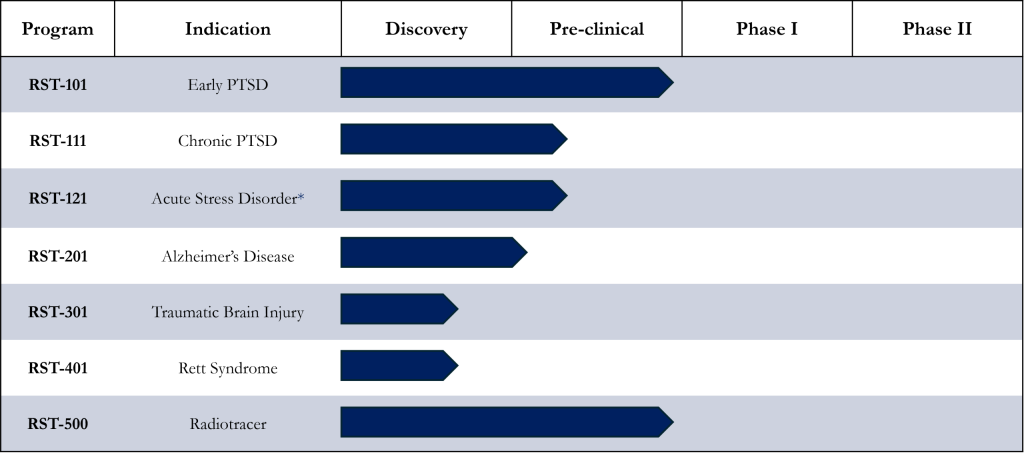
RST-101
Early Treatment for PTSD
RST-01 is a novel and proprietary chemical entity specifically targeting certain NMDA receptor subtypes involved in synaptic plasticity. It facilitates stress extinction and neuroprotection without triggering the adverse side effects classically encountered with less selective NMDA targeting drugs. RST-01 restores the memorization process when taken following a traumatic event.
RST-101: Mechanism of Action
Specifically Inhibits NMDAR GluN2D Subunit
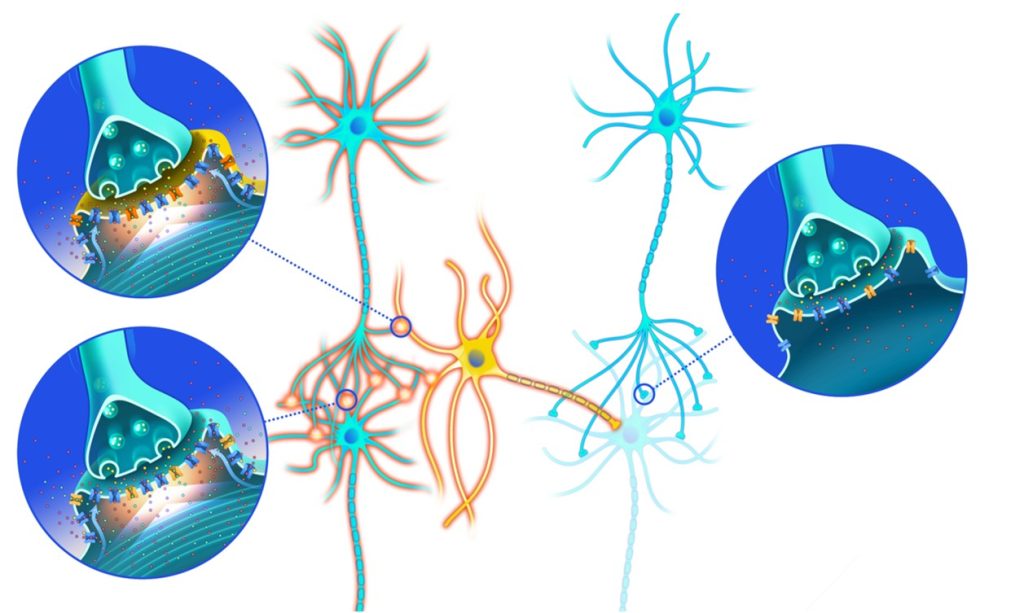
Interneuron Mediated Function Disrupted Following Trauma
Overactivated pyramidal neurons result in the excitotoxicity and reduced plasticity
Activated inhibitory interneurons prevent normal memory formation.
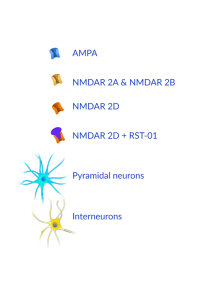
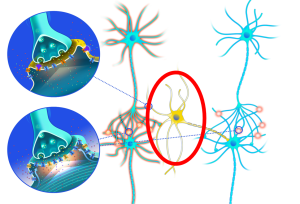
Pyramidal Function Restoration, through RST-101 Interneuron Engagement
RST-01 Specifically targets NMDA receptors subtype GluN2D on inhibitory interneurons associated with learnings and memory formation
Enables memory rebalancing while preventing side effects due to the absence of NMDAR GluN2A & GluN2B inhibition of pyramidal neurons
Scientific Publications
Our research has been peer reviewed and published in leading scientific journals
•Briana K. Chen et al.; Fluoroethylnormemantine, A novel derivative of memantine, facilitates extinction learning without sensorimotor deficits International Journal of Neuropsychopharmacology (2021)
•Briana K. Chen et al.; Fluoroethylnormemantine, a Novel NMDA Receptor Antagonist, for the Prevention and Treatment of Stress-Induced Maladaptive Behavior. Biological Psychiatry (2021)
•Langreck, Cory B. et al.; Mu Opioid Receptor Activation is Required for NMDA Receptor Antagonist Effects on Stress-induced Maladaptive Behavior, Biological Psychiatry (2025)
•Simon Couly et al.; Anti-amnesic and neuroprotective effects of Fluoroethylnormemantine in a pharmacological mouse model of Alzheimer’s disease; International Journal of Neuropsychopharmacology (2020)
•Allison Carles et al.; Neuroprotective effects of Fluoroethylnormemantine (FENM) in the Aß25-35 mouse model of Alzheimer’s disease: chronic infusion by Alzet pumps and long-term efficacy; Neurosciences (2022)
•Freyssin A, Carles A, Guehairia S, Rubinstenn G, Maurice T. Fluoroethylnormemantine (FENM) shows synergistic protection in combination with a sigma-1 receptor agonist in a mouse model of Alzheimer’s disease. Neuropharmacology (2023)
•Freyssin, A., Carles, A., Moha, B., Rubinstenn, G., & Maurice, T. (2024). Long-Term Treatment with Fluoroethylnormemantine (FENM) Alleviated Memory Deficits, Amyloid Pathology, and Microglial Reaction in APP/PS1 Mice. ACS Pharmacology & Translational Science, 7(12) (2024)
•Carles, A., Freyssin, A., Guehairia, S., Reguero, T., Vignes, M., Hirbec, H., Rubinstenn, G., & Maurice, T. Neuroprotection by Chronic Administration of Fluoroethylnormemantine (FENM) in mouse models of Alzheimer’s disease. Alzheimer’s Research & Therapy, 17(1) (2025)
•Anne-Sophie Salabert et al.; Radiolabeling of [18F]-fluoroethylnormemantine and initial in vivo evaluation of this innovative PET tracer for imaging the PCP sites of NMDA receptors; Nuclear Medicine and Biology (2015)
•Anne-Sophie Salabert et al.; Evaluation of [18F]FNM biodistribution and dosimetry based on whole-body PET imaging of rats; Nuclear Medicine and Biology (2018)
•Marie Beaurain et al.; Pharmacological Characterization of [18F]-FNM and Evaluation of NMDA Receptors Activation in a Rat Brain Injury Model; Mol Imaging Biol. (2023)
ReST Therapeutics
Global Office Locations